
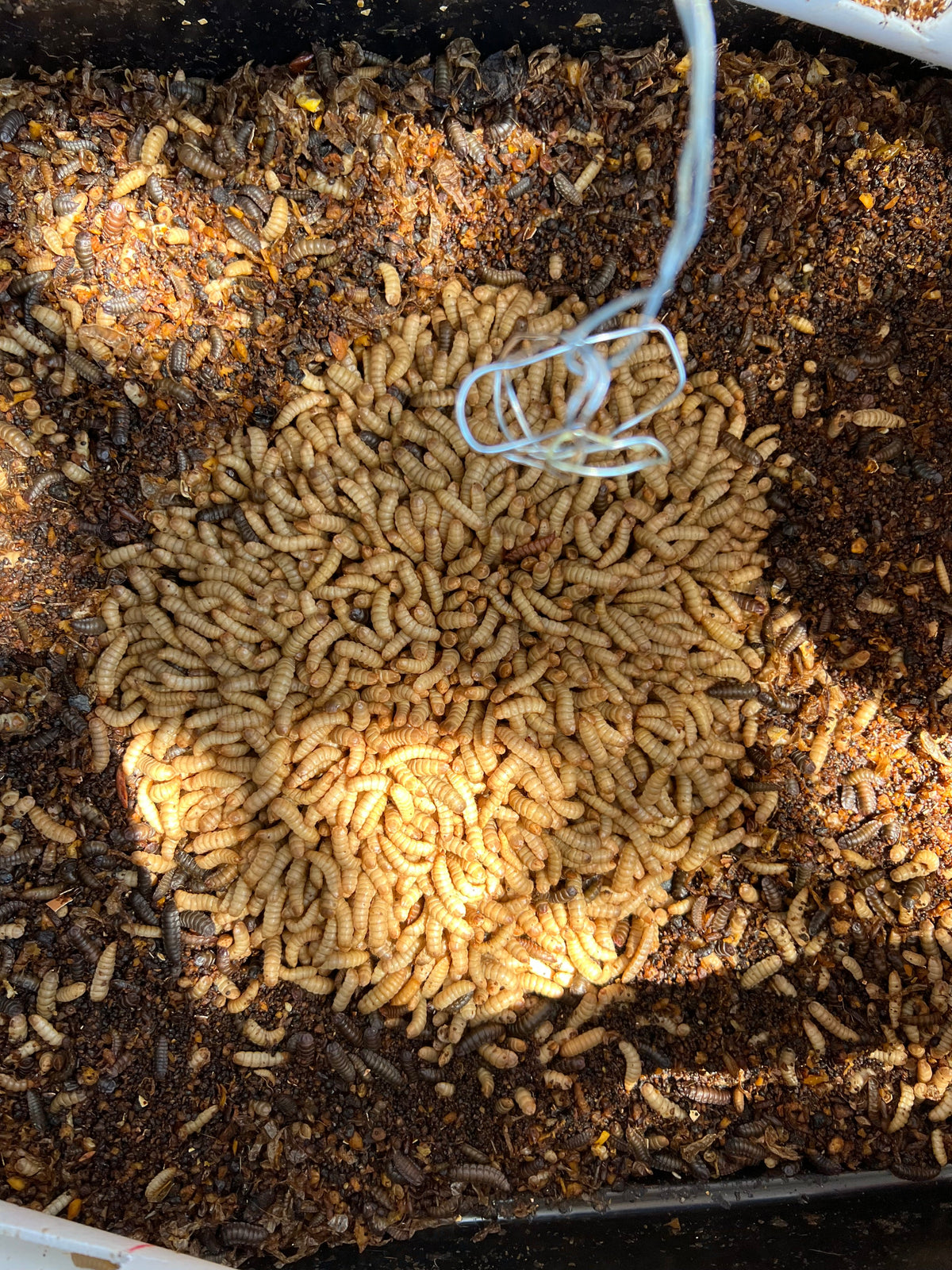
Starting a Black Soldier Fly Larvae colony at home takes a bin, some food scraps, a heat source, and about three to five weeks before you're harvesting. The setup is simpler than most people expect, the main things that trip up new colony keepers are moisture control, temperature, and lighting for the adult breeding cage.
I started with a 27-gallon black bin and a thousand larvae and didn't have any idea what I was doing. I tried a few setups that went anaerobic fast, I underestimated how dry Colorado winters are, and I learned a lot from that. What I'm walking you through below is what actually works.
What You Need Before You Start
A working BSFL colony needs four things: a rearing bin for larvae, a separate adult breeding cage, a reliable heat source, and organic waste to feed them. You don't need to spend a lot to get going, the 27-gallon black plastic bin I started with cost less than $15.
- Rearing bin: A dark 27-gallon or larger plastic storage bin. Dark bins keep light levels low, which larvae prefer.
- Adult breeding cage: Minimum 1 cubic meter, roughly 3'×3'×3'. Adults mate aerially and cramped cages suppress mating. Screen or insect netting construction. Bigger is better.
- Heat source: You need to hold 27–30°C (80–86°F) year-round. In Colorado, that means dedicated indoor space with supplemental heat. Larval development nearly stops below about 15°C (59°F), and sustained cold near freezing (0°C / 32°F) will kill a colony.
- Egg collection material: Corrugated cardboard strips. Females lay in the flutes, position them 2–5 cm above your attractant substrate and replace every 1–2 days.
If you're in Colorado or anywhere with hard winters, heating is the first problem you solve. A single cold night can wipe out a colony.
The BSFL Lifecycle, What's Actually Happening in Your Bin
The Black Soldier Fly completes its lifecycle from egg to adult in roughly 38–45 days under good conditions.
Eggs hatch in about 4 days at 27–30°C. Females lay in dry crevices above the substrate, not in it. Corrugated cardboard positioned correctly above your attractant material is the standard egg trap. Move collected eggs to hatching substrate immediately.
Early larvae (1st–2nd instar) are tiny, about 1mm at hatch. Desiccation is their number one killer in the first few days. They need 60–75% relative humidity and substrate moisture around 60–70% by weight. Squeeze a handful: it should clump without dripping. Too dry and you'll lose them before they get started.
Growth larvae (3rd–5th instar) spend 14–21 days eating and gaining weight. Optimal temperature is 27–30°C, tolerable range up to 35°C. Feed at 10–15% of larval biomass per day. If food's gone in under 12 hours, feed a little more. If food's still there after 36 hours, cut back, excess moisture from overfeeding is how bins go anaerobic.
Prepupae are your harvest window. They darken, stop feeding, and migrate toward cooler, drier areas, that self-harvesting instinct is something you can use. A ramp angled from your bin into a collection container works well. Prepupae have the highest protein and fat content of any stage.
Adults live 8–14 days and don't eat at all, they run on fat reserves. They need bright light to mate, space to fly, and ambient temperature above 24°C. The mamas die after laying.
Temperature and Humidity: The Two Most Common Failure Points
Most BSFL colony failures trace back to temperature or humidity, not to the colony being "difficult." Optimal larval development happens at 27–30°C (80–86°F), with a working range of 25–35°C (77–95°F). Below 23°C (73°F), adult mating drops sharply. Larval development nearly stalls below about 15°C (59°F), and eggs stop hatching around 13°C (55°F). Sustained temperatures near freezing (0°C / 32°F) will kill a colony outright.
For humidity: neonates need 60–75% relative humidity to survive the first days. Colorado's winter heating air is chronically dry, an ultrasonic humidifier on a humidity controller (the Inkbird IHC-200 runs about $35) handles this without manual intervention. Set it to hold 65% and leave it.
If larvae are evacuating your bin en masse, the substrate has almost certainly gone anaerobic. That's what happens when it's too wet, too dense, or overfed, it quickly gets unmanageable. Add dry carbon material (cardboard scraps, straw, or spent grain), stop feeding for a day or two, and aerate. If it smells like ammonia, that's your confirmation.
Adult Cage Lighting: The Most Overlooked Requirement
Adults need high-intensity light to mate, and this is where more indoor colonies fail than anywhere else. The minimum light intensity threshold for mating is 63 µmol/m²/s, most successful setups run above 200 µmol/m²/s. A practical rule: if you can look directly at the light source without squinting, it's probably not bright enough.
What works: full-spectrum LEDs with a UV component, metal halide or quartz-iodine halogen bulbs, direct sunlight. What doesn't: standard shop fluorescents, regular household LED bulbs, plant grow lights without a UV spectrum component. Run a 16-hour photoperiod (16 hours on, 8 off). If adults aren't mating despite holding temperature above 24°C, lighting is the problem.
What to Feed Your Colony
BSFL can process most organic waste, fruit and vegetable scraps, spent brewing grain, poultry mash, coffee grounds, and most pre-consumer food waste. A reliable starting feedstock is the Gainesville diet: 50% wheat bran, 30% alfalfa meal, 20% corn meal. It's consistent, doesn't cause moisture swings, and larvae process it readily from the first days.
Feed rate: 10–15% of larval biomass per day. If food disappears in under 12 hours, feed a bit more. If there's still food after 36 hours, cut back, overfeeding is the direct path to anaerobic substrate.
Avoid large quantities of meat scraps (high pathogen load), anything heavily salted or acidic, and pesticide-contaminated produce. Wet, fruit-heavy feedstocks spike moisture fast, balance them with dry carbon material.
Common Problems and How to Fix Them
Larvae evacuating the bin. Almost always anaerobic substrate. Add dry carbon, aerate, stop feeding for 24–48 hours. Ammonia smell confirms it.
No eggs being laid. Check lighting first (most common cause), then cage temperature (should hold ≥24°C), then whether attractant substrate is positioned under your egg traps. Introducing 500–1,000 young larvae into the attractant material provides chemical signals that encourage oviposition.
Neonates dying in the first few days. Temperature too low or substrate too dry. Verify you're holding ≥25°C and that substrate moisture is clumping-but-not-dripping.
Adults dying within 3–4 days. Check for shallow water access (a saturated sponge, adults can drown in open water), and confirm ambient cage temp isn't exceeding 35°C.
Low hatch rate. Either unfertilized eggs from poor mating conditions, or desiccation of eggs post-collection. Improve cage lighting and mating conditions; keep collected eggs at 60–70% relative humidity.
Frequently Asked Questions
Q: How long does it take to start a BSFL colony from scratch?
A: About a month to your first prepupae if your temps and moisture are right. The first generation always takes longer, you're learning your setup as much as they're growing.
Q: Do I need both a breeding cage and a rearing bin?
A: Yeah. Adults want bright and airy. Larvae want dark and damp. Those are opposite environments. Two separate setups.
Q: Can I start a BSFL colony indoors in Colorado?
A: That's what I do. You're committing to year-round heating and humidification, but it works. Just don't assume a garage counts as "indoors" in January.
Q: What's the best feedstock to start with?
A: Gainesville diet. It's boring on purpose, no moisture surprises, no weird pH swings. Get your colony stable first, then start experimenting with kitchen scraps.
Q: Why are my adults not mating?
A: Check your lights. If you can stare directly at the light source without squinting, it's not bright enough. That catches most people off guard, BSF need way more light intensity than you'd expect.
Q: How do I harvest prepupae without digging through the bin?
A: Build a ramp. They want out when they're ready to pupate. Give them a path to a collection bucket and they'll do the work for you.
Q: Do BSFL smell bad?
A: Not when things are going right. A healthy bin smells like dirt. If you're getting ammonia, something went sideways, usually too wet or overfed. Fix that and the smell goes away.
