
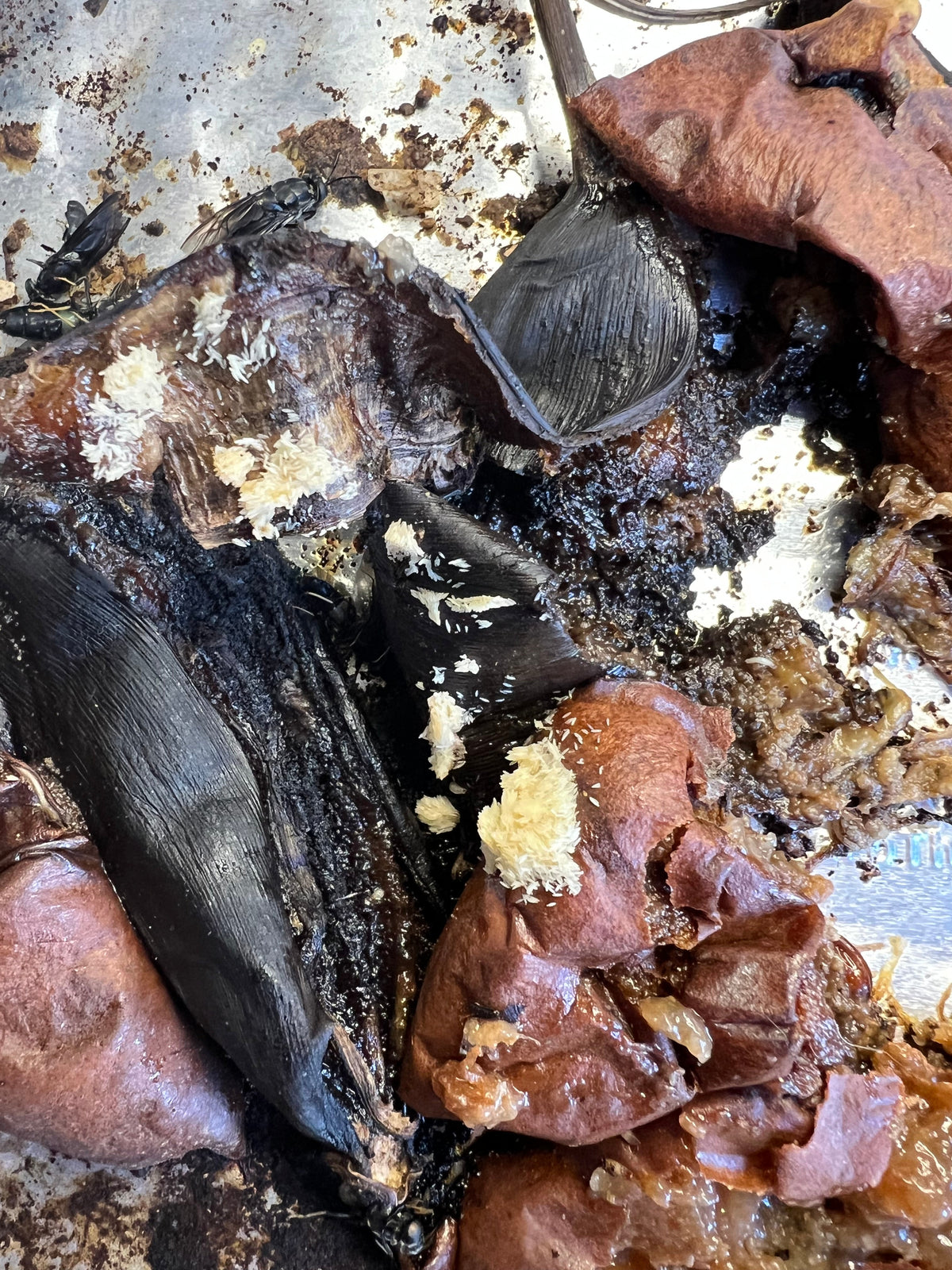
I suppose they will, but can you call it eating? It's a weak feedstock, basically dirt. Caffeinated dirt. I just found out that a manufacturer of a popular BSFL pod, recommends that you lay several cups of spent coffee grinds at the bottom of their pod and that seems wildly irresponsible to me. So I did some further research.
So many people say that coffee grinds are great for BSFL and I just don't believe that and the studies I found don't back those claims up either.
First off, it's going to give you weak ass larvae
Spent coffee grounds are what's left after the brew pulls out most of the good stuff. By the numbers, they run a low protein-to-carbohydrate ratio, high crude fiber, and low crude lipid (fat). That's close to the opposite of what a growing larva wants. BSFL grow fastest and biggest on substrates sitting around 20% protein and 20% carbohydrate. Grounds miss that target.
You can see it in the growth data. In one feeding-rate study out of Bandung, Indonesia, larvae raised on spent grounds alone took roughly 25 to 27 days to reach the prepupal stage. For reference, on a good substrate I'm harvesting in 14 to 18 days. Even at the highest feeding rate they tested, the growth rate stayed low. The larvae survived. They just developed slowly and came out smaller.
A 2024 study backed this up from another angle. When researchers mixed spent grounds with blood meal and compared the result against a plain chicken-feed control, the chicken feed won easily, and the coffee-grounds mix produced the lowest growth of the bunch. The pattern across the literature is consistent: grounds supply some usable nutrients, but they slow the colony down.
You're gonna get some tweaked out animals
Brewing coffee does not pull all the caffeine out — there's still a lot in the spent grounds. A 2024 systematic review on coffee grounds as BSFL feed flagged caffeine as the main risk, noting that high concentrations can be toxic to the larvae and can carry through to the animals that eventually eat them.
So that means if your BSFL are eating coffee grounds, your chickens and reptiles are ingesting caffeine, and I'm pretty sure that double espresso grubs aren't great for those little hearts.
It's basically dirt, and dirt isn't good for a BSFL bin.
If you take one thing from this post, take this: do not pack a thick layer of coffee grounds into the bottom of a rearing bin.
The problem is mechanical before it's anything else. Grounds are fine-particled and they compact hard. A thick layer presses down under its own weight, stops breathing, and goes anaerobic. The bottom of the bin is already the wettest part, it's where moisture and leachate collect. So you'd be putting your most compaction-prone, water-holding material in the exact spot most likely to turn sour. This is when you have a mass-exodus from your bin the larvae have to evacuate the substrate or die, and you're left with a wet, ammonia-stinking bottom layer.
A thick layer also concentrates the caffeine exposure instead of diluting it. Scattered through a mixed bin, the dose is low. As a dense slab the larvae have to live in and crawl through, it's the opposite.
Where coffee grounds shine is egg laying bait.
When I am trying to get the gravid flies to lay eggs where I want them to I make irresistible egg laying bait. I use either some fermented oatmeal or spent brewery grain, add some fruit that is going bad, and those coffee grinds. This is like a beacon of funk that those mommas cannot resist.
If you need something to manage moisture or build air channels at the bottom of the bin, grounds do the opposite of what you need. You want coarse material that holds structure: cardboard strips, wood shavings, coir, chopped straw, or spent brewery grain. Spent grain in particular is a much better carbon-balancing add than coffee, it's already on the short list of substrates BSFL genuinely thrive on.
I just feel like giving caffeine to small animals is not going to end well, so I don't want you to do it inadvertently. You should probably ask your larvae hookup if their grubs are fed a lot of used coffee.
Sources
- Putra, R.E., et al. "Growth of Black Soldier Fly (Hermetia illucens) Larvae Fed on Spent Coffee Ground." IOP Conference Series: Earth and Environmental Science, vol. 187, 2018. (Feeding-rate study; 25–27 day development on spent grounds; nutritional profile.)
- "Improved nutritional and antioxidant properties of black soldier fly larvae reared on spent coffee grounds and blood meal by-products." 2024. PubMed ID: 39614531. (Coffee-grounds/blood-meal mix produced the lowest growth versus a chicken-feed control.)
- "Cultivation of Black Soldier Fly (Hermetia illucens) Larvae for the Valorization of Spent Coffee Ground: A Systematic Review and Bibliometric Study." Agriculture (MDPI), 2024, 14(2):205. (Caffeine flagged as the primary toxicity and bioaccumulation risk.)
- Khaekratoke, K., et al. "Use of fermented spent coffee grounds as a substrate supplement for rearing black soldier fly larvae, Hermetia illucens (L.)." PeerJ, 2022, 10:e14340. DOI: 10.7717/peerj.14340. (Fermented grounds used as a supplement in fruit–vegetable feed, not as a base substrate.)
