
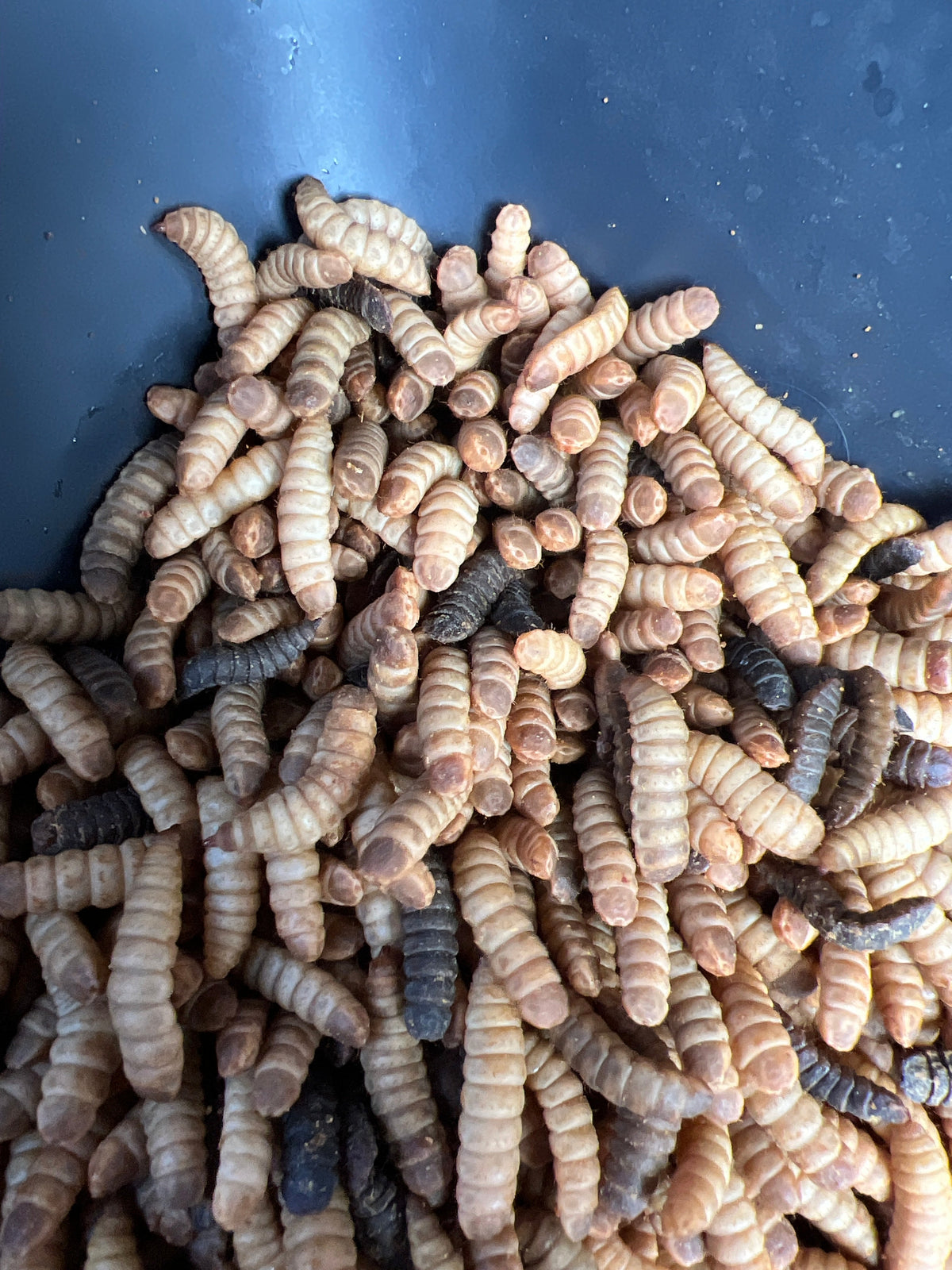
The Calcium Question (And Why It Matters More Than Protein)
This is where I'd start if someone cornered me at a reptile expo and asked "why BSFL?", because it's the single biggest practical difference between these three feeders.
BSFL have a calcium-to-phosphorus ratio of roughly 1.5:1. That's close to the 2:1 ratio most reptiles need. Crickets and mealworms? Their ratios are inverted, way more phosphorus than calcium. Feed them without dusting and you're setting your animal up for metabolic bone disease over time. I've seen it happen. It's not pretty.
We're talking about a 50-fold difference in calcium content. BSFL can hit 8,000+ ppm calcium on a dry-weight basis. Crickets and mealworms sit at 20 to 135 ppm. That's not a rounding error, it's a completely different category.
What that means in practice: every time you feed crickets or mealworms, you need to dust them with calcium powder first. Every single time. With BSFL, you generally don't. If you're feeding daily, that saves you real time and money over the course of a year. I stopped dusting when I switched my beardies to a BSFL-heavy rotation, and my vet has had zero concerns at checkups since.
What About Protein?
Crickets win this one. Around 60 to 65% protein on a dry-weight basis, though it swings depending on how old the crickets are and what they've been eating. Mealworms land around 50 to 55%. BSFL come in lower at about 40 to 42%.
But here's the thing, for most reptiles in captivity, any of those protein levels is more than adequate. The protein gap sounds dramatic in a comparison table, but it's rarely the limiting factor in your animal's health. Ca:P ratio and fat content are doing more to determine long-term outcomes than whether your feeder is 42% or 62% protein.
Fat: Where Mealworms Get You in Trouble
Mealworms are fatty, 20 to 25% fat by dry weight, and the fat is mostly oleic and linoleic acids. Feed them as a staple and you're looking at obesity and fatty liver disease (hepatic lipidosis) down the road. I've talked to keepers who lost animals to this because they thought mealworms were a fine everyday feeder. They're not. They're a treat. A good treat, my leopard geckos go absolutely nuts for them, but a treat.
BSFL are also on the fattier side at 29 to 35% dry weight, but the fat profile is different. About a third of the fatty acids in BSFL are lauric acid, a medium-chain fatty acid, the same kind found in coconut oil. It's a completely different fat profile from mealworms. I'm not going to pretend fat content doesn't matter with BSFL, it does, and you should be feeding a variety regardless of what your primary feeder is.
Crickets are the lean option. Around 6 to 13% fat. If you've got a reptile that needs to drop weight or maintain a lean body condition, crickets are your friend on this front.
Living With Them: Smell, Noise, and the Great Escape
Let me tell you about the time I had a cricket colony in my office closet. The chirping was, I'm going to be diplomatic here, relentless. My wife could hear them through two closed doors. They escaped constantly. I'd find dead crickets behind furniture for months after I finally gave up on keeping them. If you've ever kept crickets at home, you know this isn't an exaggeration.
Crickets need ventilation, specific temperature and humidity, regular food and water gel, and they still die on you in batches for reasons you'll never fully figure out. They're the highest-maintenance feeder by a wide margin.
Mealworms are the opposite end of the spectrum. Toss them in a container, stick it in the fridge, and they'll keep for weeks. No chirping. No escaping. No drama. That's mealworms' whole value proposition, zero effort.
BSFL are closer to the mealworm end. Low maintenance, quiet, contained. The one thing that catches people off guard: when larvae hit the prepupal stage, they want out. They'll climb walls, crawl up ramps, and generally make a run for it. This is actually by design if you have a self-harvesting bin, it's how you collect them. But if you're storing larvae in an open container on your counter, you're going to have some adventurous grubs on your floor. Ask me how I know.
Raising Your Own: Where BSFL Pull Away
This is my wheelhouse, so I'll try to be fair.
BSFL eat food scraps you're already throwing away. Coffee grounds, fruit trimmings, vegetable peels, spent grain if you homebrew, they're not picky. They self-harvest by crawling up a ramp when they're ready to pupate. A small colony in a bin in your garage can give you a steady supply of feeders with maybe 20 minutes of attention per week. I run a full production operation, but even a casual setup works.
Crickets can be bred at home, but it's more involved. You need to manage temperature, humidity, prevent die-offs, deal with the noise, and contain the escapes. It's more work to get going and more work to maintain. Some people do it successfully, I just wasn't one of them.
Mealworms breed at home too. They're quiet and contained, which is nice. But the lifecycle is slow, you're managing beetle colonies, waiting through a long pupation period, and the production volume per unit of effort is lower than BSFL.
If you want a self-sustaining feeder supply with the least ongoing effort, BSFL are it. That's not just my sales pitch, it's what I've seen after trying all three. The easiest way to start is a bin that does the harvesting for you — our BSFL Bin Kit handles the fly entrance, egg-laying surfaces, and the self-harvesting ramp. Here's our guide to starting a colony if you want to try it.
Which Reptiles Will Actually Eat BSFL?
Most of the common insectivores and omnivores take them without much convincing. Bearded dragons, leopard geckos, blue-tongued skinks, crested geckos, chameleons, all good. Aquatic turtles love them. Some frogs do too. The wriggling motion of a live larva gets the attention of anything that hunts by sight.
That said, some reptiles are stubborn about new foods. If your animal turns its nose up at BSFL the first time, try mixing a few in with whatever they already eat and slowly increasing the ratio. Patience works better than going cold turkey.
The Bottom Line
I'll say it plainly: if I had to pick one feeder to build a reptile diet around, it's BSFL. The calcium alone makes everything easier, no dusting, no worrying about MBD, no extra supplements on every feeding. The fat content is real, but the fatty acid profile is better than mealworms, and you manage it the same way you manage any diet: variety.
Crickets bring the most protein and the least fat. But the Ca:P ratio is terrible, you must dust every feeding. They're loud, they escape, they die easily, and keeping them alive is a whole project. Gut-loading helps their nutrition a lot. They're a solid supplement feeder, not something I'd want as my only option.
Mealworms are convenient, refrigerate them and forget about them until feeding time. Decent protein. But the fat content makes them a poor staple, and the Ca:P ratio means mandatory dusting. Good as an occasional treat. My geckos would eat them exclusively if I let them, which is exactly why I don't.
Use BSFL as your backbone. Rotate in crickets for the protein hit a couple times a week. Throw in a mealworm now and then because your gecko earned it. That's what I do, and my vet bills are boring, which is exactly what you want.
Frequently Asked Questions
Do BSFL need to be dusted with calcium?
I don't dust mine, and my vet hasn't flagged it in years. BSFL already sit at roughly 1.5:1 Ca:P, which is close enough for most healthy reptiles on a varied diet. If your animal has a known calcium deficiency or your vet says to supplement, listen to your vet, but for routine feeding, the dust stays in the jar.
Can I feed my bearded dragon only BSFL?
I wouldn't. My beardies eat BSFL as their main insect, but they also get crickets a couple times a week, the occasional mealworm, and a pile of collard greens and squash every day. Adult bearded dragons should be eating more greens than insects anyway. BSFL are the best single feeder option, but "best single feeder" still isn't "only feeder."
Are BSFL better than crickets?
For most keepers, yes. The calcium advantage alone saves you time and money on dusting, and you won't have crickets chirping through your bedroom wall at 2 AM. Crickets bring more protein, which matters if you're feeding a young, fast-growing animal that needs the extra fuel. I use both, but BSFL do the heavy lifting in my rotation and I'd pick them ten times out of ten if I could only keep one.
Why do mealworms cause health problems?
It's the fat. At 20-25% dry weight, feeding mealworms as a daily staple is like putting your gecko on a fast food diet. Over months, that leads to fatty liver and obesity, I've talked to keepers at expos who lost animals this way. A few mealworms a week won't hurt anything. A mealworm every meal, every day, will.
