
What Is a Black Soldier Fly?
The Black Soldier Fly (Hermetia illucens) is a non-pest fly in the family Stratiomyidae. Adults are about 15–20mm long, dark-colored, and often mistaken for wasps due to their body shape, though they have no stinger and cannot bite. Adult flies don't eat solid food, their sole purpose is to mate and lay eggs. They live 5–14 days, fueled entirely by fat reserves built up during the larval stage.
Unlike houseflies, Black Soldier Flies are not attracted to human food, do not regurgitate on surfaces, and are not considered sanitation risks. Their larvae process organic waste faster and more thoroughly than almost any other decomposer, which is why entomologists classify them as beneficial insects.
What Do the Larvae Do?
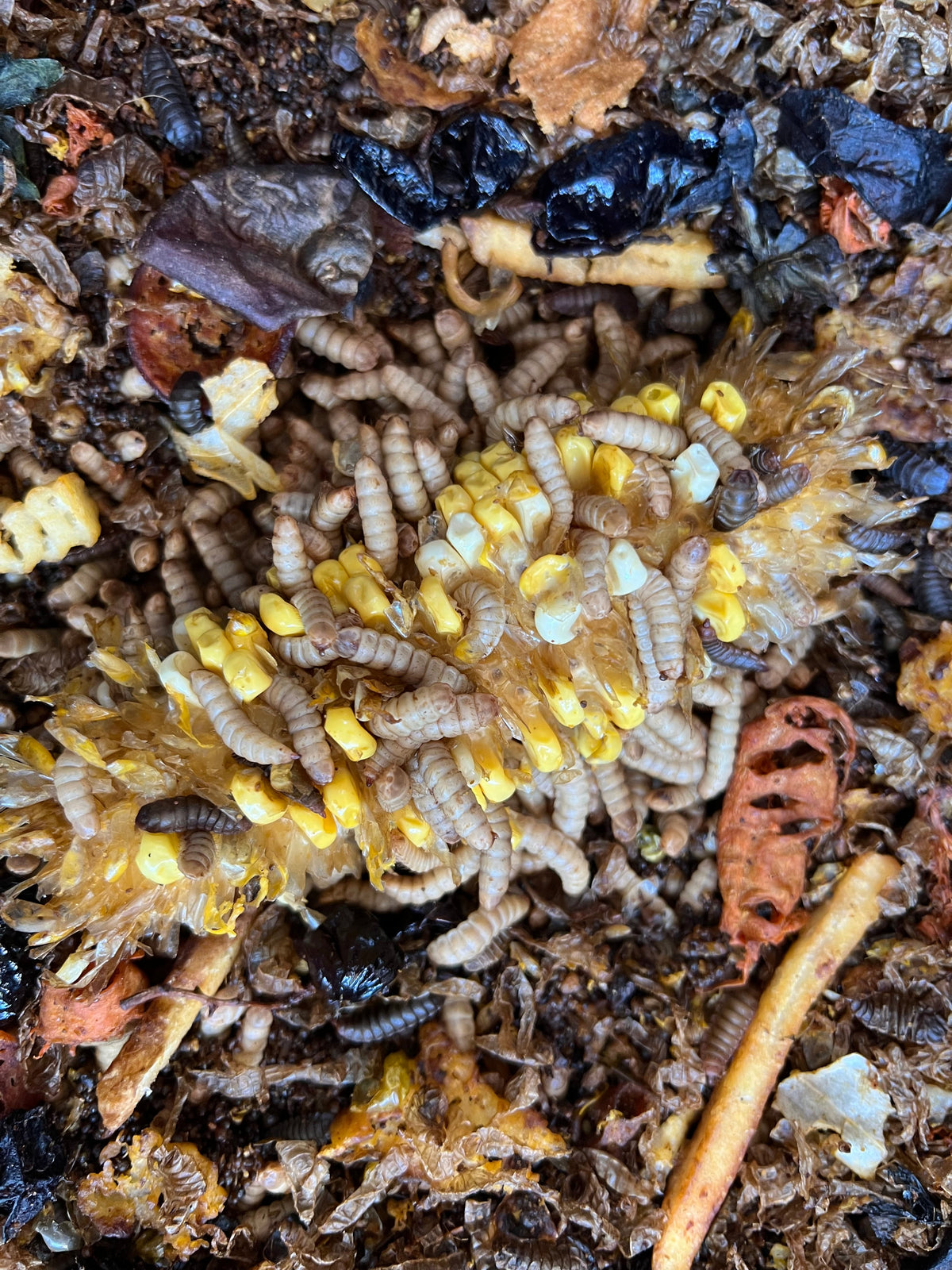
Black Soldier Fly Larvae eat organic waste — fruit and vegetable scraps, coffee grounds, grain products, eggshells — and convert it into their own body mass. A single larva eats roughly twice its body weight in food per day at peak growth, going from a 1mm hatchling to a 25mm cream-colored grub over a 2–3 week feeding period. When they're done, larvae darken, stop eating, and crawl away from the food source on their own. That self-harvesting behavior means you collect them with a ramp or exit tube instead of picking through substrate by hand.
The nutritional profile at harvest is what sets BSFL apart from other feeder insects. Larvae contain roughly 40% protein and 5–8% calcium by dry weight, for comparison, mealworms run about 0.1% calcium and crickets about 0.08%. The calcium-to-phosphorus ratio sits around 1.5:1, close to the 2:1 target for most reptiles. The frass they leave behind, the digested residue of their feeding, runs about 3–5% nitrogen and contains 5–8% chitin by dry weight. Chitin triggers induced systemic resistance in plants, activating defense pathways that suppress soil-borne fungal pathogens like Fusarium and Pythium. It's not a vague "soil health" benefit, it's a specific, measurable immune response.
Who Raises BSFL and Why?
Black Soldier Fly Larvae are raised primarily by reptile owners, backyard poultry keepers, home composters, and hobbyist insect farmers. Reptile owners are probably the largest group of individual BSFL buyers. Bearded dragons, leopard geckos, chameleons, and most other insectivorous reptiles take larvae readily, and the calcium-to-phosphorus ratio means you can skip the calcium dusting that crickets and mealworms require. One feeder that doesn't need supplementation is a real simplification for daily care.
Backyard poultry keepers are the other big market. If you've never tossed a handful of grubs into a chicken run, you're missing out on pure chaos in the best way possible, birds go absolutely nuts for them. BSFL are one of the few treats that actually improve flock nutrition instead of diluting it. The calcium supports strong eggshells without extra supplementation, and the protein helps during molt and winter when birds need it most.
Home composters use BSFL to process kitchen scraps faster and more completely than traditional compost bins. A colony of a few thousand larvae handles a household's daily food waste continuously, and the resulting frass goes straight into the garden.
Hobbyist insect farmers raise them as a first species, the lifecycle is short, the setup is simple, and they're forgiving of beginner mistakes. Some scale up to sell dried larvae locally or supply frass to gardeners in their area.
The BSFL Life Cycle
The Black Soldier Fly Larvae life cycle runs from egg to adult in about 5–6 weeks under warm conditions (27–30°C / 80–86°F). It slows considerably below 25°C and stalls below about 15°C.
Females lay 200–600 eggs per clutch — up to about 1,500 over a lifetime — in dry crevices near a food source, not on the food itself, but in gaps and corrugations close by. Eggs hatch in 3–5 days into tiny larvae that immediately begin feeding. Over the next 2–3 weeks, they pass through several instars, growing from nearly invisible hatchlings to cream-colored grubs about 20–25mm long. This is the stage most people interact with: active, visibly feeding, and easy to handle.
When larvae finish growing, they enter the prepupal stage. They stop eating, darken from cream to near-black, and migrate away from the food source. This is the self-harvesting behavior that makes BSFL practical to raise, a ramp or exit tube collects prepupae automatically with no manual sorting. Pupation takes 10–14 days. Adult flies emerge, mate within a day or two, lay eggs, and die within 5–14 days. They don't eat as adults. The entire adult phase exists solely for reproduction.
Are BSFL the Same as Maggots?
Black Soldier Fly Larvae are not the same as the maggots most people picture. Technically, "maggot" refers to any fly larva, but the word carries associations with housefly larvae, disease, and decay that don't apply to BSFL. Black Soldier Fly Larvae are raised in clean conditions on food-grade substrates, not on rotting waste or carcasses. We don't use the word, we call them larvae, grubs, or BSFL.
Are BSFL Available to Buy?
Black Soldier Fly Larvae are available to buy in both dried and live form. Dried BSFL are sold as a feeder and supplement in many pet stores and online. Live larvae are harder to find commercially but can be raised at home with a basic setup. The Blue Grub Farms Bin Kit is designed specifically for first-time BSFL growers, it includes everything needed to start a colony from scratch.
Frequently Asked Questions
Do Black Soldier Flies bite?
No. Adult Black Soldier Flies have no functional mouthparts for biting or stinging. Larvae also do not bite humans.
Are Black Soldier Flies a pest?
No. They are classified as beneficial insects. Adults don't enter homes seeking food, don't damage structures, and are not disease vectors. Larvae only appear where organic waste is present, they don't infest clean environments.
Do BSFL smell?
A well-managed BSFL bin has a mild earthy smell, similar to a healthy compost pile. Poor airflow, too much moisture, or overfeeding can cause odor. A properly maintained bin is not objectionable to most people.
Where do Black Soldier Flies live naturally?
Hermetia illucens is native to the Americas but has spread globally through trade and is now found across most tropical and subtropical regions. In North America they are common throughout the southern and western United States, including Colorado.
