
by Travis Berryhill, Blue Grub Farms
Starting a BSFL frass farm from scratch requires four things in the right order: a controlled rearing environment, reliable heat, quality feedstock, and adequate breeding light. Get those four right and you can build a consistent frass operation within 4–6 months. Get any of them wrong and the colony will tell you immediately.
I get messages pretty regularly from people who want to start a Black Soldier Fly operation at scale. They've got land, they've got money, they've done some reading, and they're ready to go. And almost every time, I give them the same advice: start small first.
Not because the idea is bad. Usually the idea is great. It's because BSFL will humble you in ways you won't see coming if you skip the learning phase.
Here's what I'd actually tell someone starting from scratch, land, budget, and zero larvae experience.
Start with what you got.
An existing outbuilding, a shed, garage, or small barn, is the right starting point for a BSFL operation before investing in purpose-built infrastructure. Before you spend money on a pole barn, a commercial rearing facility, or any kind of custom build, you want to spend a season getting to know these animals.
BSFL are not complicated, but they're specific. They have tight requirements around temperature, humidity, substrate moisture, and lighting, and until you've run a colony through a full cycle, you won't really know where your operation is going to break down. And it will break down somewhere the first time. That's cool, you learned something.
A shed lets you make those mistakes cheaply. It lets you figure out whether your heat source keeps up on a cold night, whether your feedstock behaves the way you think it will, whether your egg collection is actually working. Once you know those answers, you build bigger with confidence. Before you know them, you're just guessing at scale.
Cold isn't an insect's friend
Cold climate BSFL operations require dedicated heating, it is your biggest infrastructure decision and the most commonly underestimated cost. If you're in a northern state, anywhere with real winters, heat is not optional.
Black Soldier Fly larvae thrive between 77–95°F (25–35°C). The lower developmental threshold for eggs is somewhere around 55–57°F (13–14°C), research puts the range at 12–16°C depending on conditions. Below that range, eggs generally won't hatch. Below 67°F (19°C), development slows dramatically and survival rates drop significantly. Expect heavy losses if your rearing space dips to this range consistently.
So if you're in a state where temperatures drop below freezing from November through March, and in the north that's roughly half the year, you're looking at 5 to 7 months where your rearing space needs to stay at a minimum of 75°F at all times. That means reliable heat, backup heat, and ideally a sensor with an alert on your phone so you know immediately if something goes wrong overnight.
The other thing cold-climate operations deal with is dry air. Forced-air heating systems strip humidity. BSFL neonates, the tiny larvae right after hatch, need 60–75% relative humidity. If your rearing room drops to 30% RH in winter, you will lose neonates. A humidifier of some sort is going to be required.
Budget for climate control before you budget for anything else.
Get your feedstock for free if you can
Spent brewers grain from a local brewery is one of the best starting feedstocks for a BSFL operation, high protein, consistent batch to batch, and often available free or cheap. That's more than you can say for general food waste.
BSFL are efficient converters, and the quality of the frass they produce is directly tied to the quality of what they eat. Feed them well-balanced, protein-rich substrate and you get better frass. Feed them garbage and you get garbage frass.
That said, brewers grain is also fairly high in nitrogen, so you'll want to watch your substrate moisture carefully. Wet, nitrogen-heavy substrate goes anaerobic fast, and when it does, ammonia builds up and the larvae will evacuate the bin or die. The fix is mixing brewers grain with a dry carbon source, cardboard, straw, or sawdust, to balance the C:N ratio and keep things aerobic. A good rule of thumb: the substrate should clump when you squeeze it but not drip. If it drips, add dry material.
Pairing brewers grain with local food waste gives you variety and keeps costs down. Just know your food waste source. Pesticide-contaminated feedstocks bioaccumulate in larvae and frass, which matters a lot if you're selling the frass as a soil amendment.
Getting lighting right is tough
Indoor BSF breeding requires high-intensity light, standard shop fluorescents and low-wattage LEDs will not trigger mating behavior. This is the single most misunderstood requirement for indoor operations and the most common reason setups fail to produce eggs consistently.
BSF adults need to mate aerially. No mating, no eggs, and mating won't happen without real light intensity and the right spectrum. That's where most indoor setups fall apart.
Here's what doesn't work: standard fluorescent shop lights, low-wattage LEDs without a UV component, plant grow lights. These don't meet the threshold.
Here's what does:
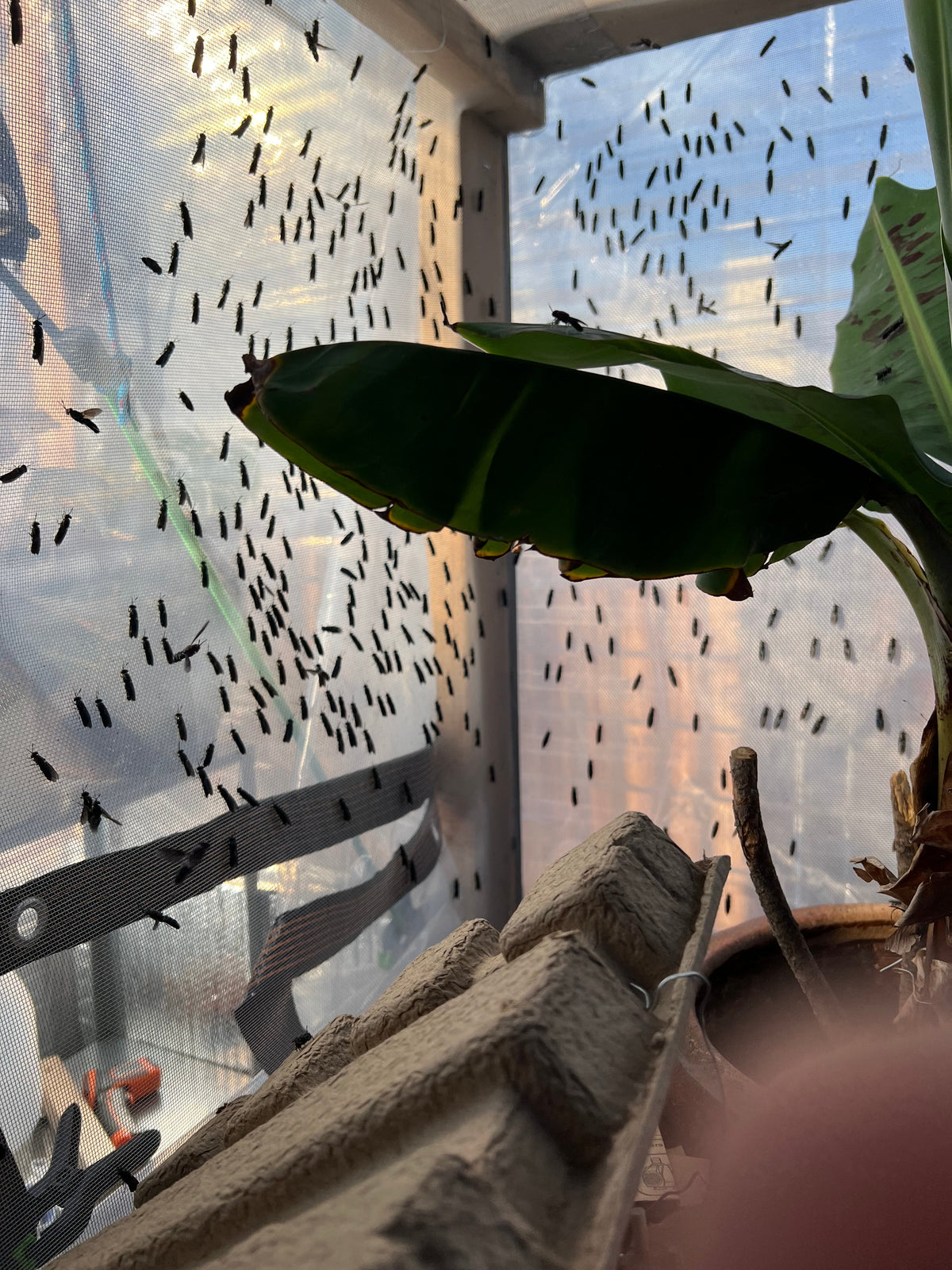
Direct sunlight is best. If you can position your breeding cage near a south-facing window with minimal filtering, that's your simplest and cheapest solution. Everything else gets compared to direct sunlight.
Quartz-iodine halogen bulbs come in at about 61% of sunlight mating rates in research settings (Nakamura et al., 2016). Metal halide is another high-output option in the same category. They run hot and cost more to operate, but they work.
Full-spectrum LEDs with a UV-A component work well and are the most practical option for most setups. Look for systems marketed for reptile or insect breeding. It comes down to intensity: you need roughly 60+ µmol/m²/s at cage level, and mating really gets going above 200 µmol/m²/s. If the light doesn't feel bright enough to be uncomfortable to look at directly, it's probably not bright enough.
Run your light on a 14-hour cycle (a simple timer does this). Mating peaks during the brightest part of the photoperiod, usually midday.
One more thing on breeding cages: size matters. Aerial mating requires actual flight space. A minimum of 1 cubic meter, roughly a 3' × 3' × 3' enclosure, is the floor. Cramped cages suppress mating even if everything else is right.
What a realistic timeline looks like
A BSFL frass operation typically takes 2–3 months to understand and 4–6 months to reach consistent frass yields from a standing start. The egg-to-adult cycle under ideal conditions is 38–45 days, but that's not your timeline.
Your timeline includes:
- Getting your rearing environment dialed in (temperature, humidity, substrate moisture)
- Getting your breeding cage producing eggs reliably
- Understanding your feedstock conversion rates
- Building up colony density to the point where you have consistent output
Realistically, if you start from a small purchased colony or egg supply, you're looking at 2–3 months before you have a working system you understand, and 4–6 months before you're pulling consistent frass yields. That's not slow, it's just honest. The first cycle teaches you what the second cycle needs.
TL;DR
If I had to condense it: use what you have (your shed), solve for heat first, use good feedstock (brewers grain is genuinely solid), and invest in real lighting for your breeding cage, it's the thing most people cheap out on and regret.
The learning phase isn't wasted time. It's the thing that makes the bigger build actually work.
If you want to talk through your specific setup, climate, feedstock, build plans, that's exactly what my consultation service is for. One hour, your situation specifically, no generic advice. You can book at bluegrubfarms.com.
Travis Berryhill is the founder of Blue Grub Farms in Aurora, Colorado. He raises BSFL full-time and sells tools and education to help other people do the same.
Frequently Asked Questions
What temperature do BSFL need for frass production?
BSFL produce frass most efficiently at 77–95°F (25–35°C). Below 67°F (19°C), larval development slows significantly and colony productivity drops. Egg hatch requires a minimum of roughly 55–57°F (12–16°C). For year-round frass production, your rearing space must stay above 75°F at all times.
How long does it take to start producing BSFL frass consistently?
Expect 4–6 months from initial colony setup to consistent frass yields. The first 2–3 months are spent dialing in your rearing environment, breeding cage, and feedstock. Frass output becomes consistent once colony density stabilizes, which takes at least one full egg-to-adult cycle (38–45 days under ideal conditions).
What is the best feedstock for quality BSFL frass?
Spent brewers grain mixed with a dry carbon source (cardboard, straw, or sawdust) produces high-quality frass reliably. The carbon source balances the C:N ratio and prevents anaerobic conditions. Avoid pesticide-contaminated food waste if the frass is intended for sale as a soil amendment, contaminants bioaccumulate in both larvae and frass.
What kind of light does an indoor BSF breeding cage need?
Indoor BSF breeding cages need high-intensity full-spectrum light with a UV-A component. Minimum intensity is roughly 60 µmol/m²/s at cage level; mating activity increases significantly above 200 µmol/m²/s. Direct sunlight through a south-facing window is the gold standard. Full-spectrum reptile or insect LEDs are the most practical alternative. Standard fluorescent shop lights and plant grow lights do not provide sufficient intensity.
Can you raise BSFL year-round in cold climates?
Yes, but it requires dedicated climate control. In states where temperatures drop below freezing from November through March, your rearing space needs reliable heat, backup heat, and humidity management to stay at or above 75°F and 60% relative humidity throughout winter. Budget for climate control infrastructure before anything else.
