
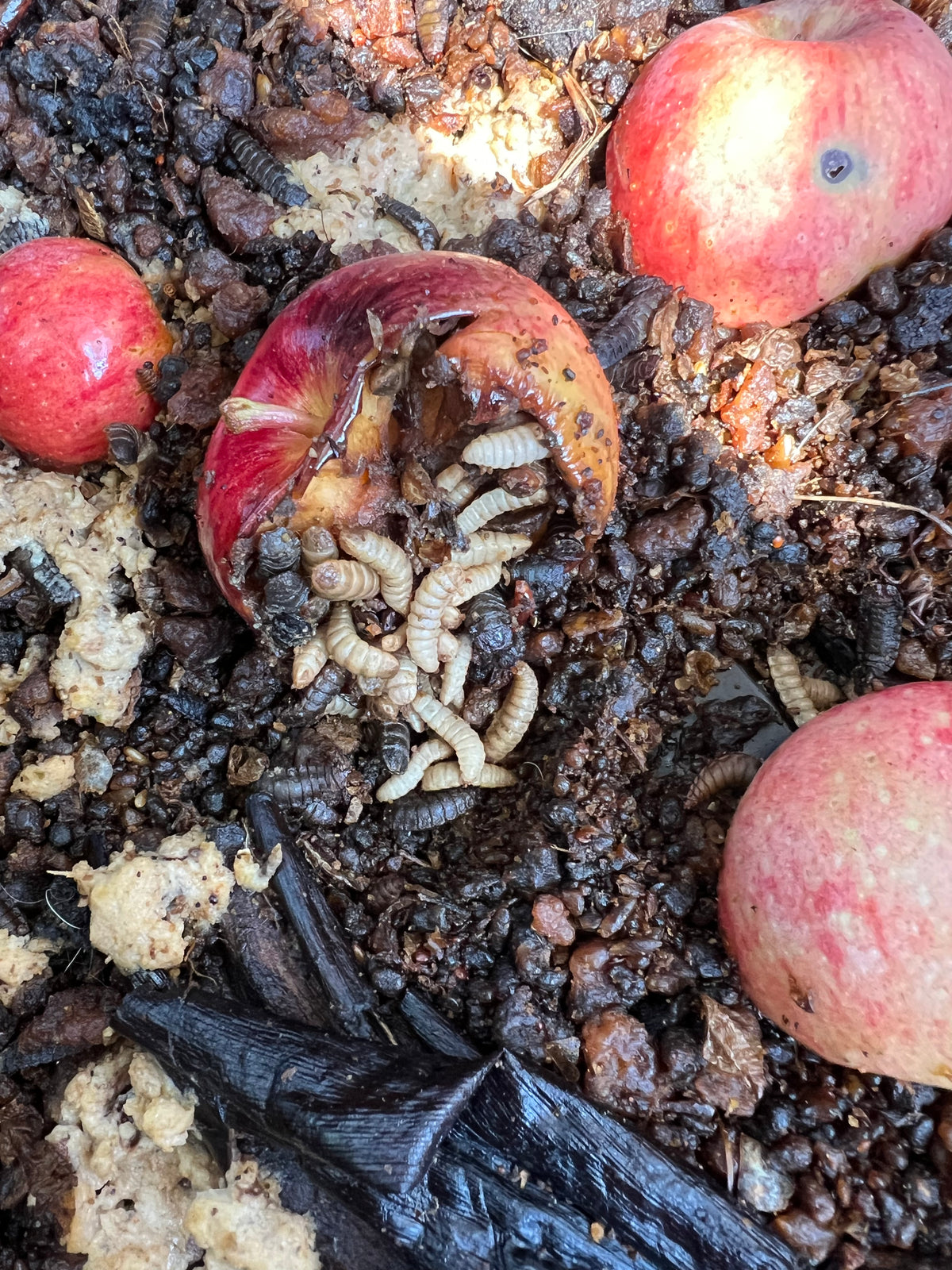
This is a question I get a lot, and it's one I care about personally because pet waste bioconversion is something we're actively building at Blue Grub Farms. The short answer is yes, BSFL can and will process pet waste. The longer answer involves some important caveats that most people skip over.
What BSFL Do With Pet Waste
Larvae will eat dog and cat feces. The organic matter gets broken down just like any other substrate, converted into larval biomass and frass. Volume reduction is comparable to what you'd see with food waste, 50 to 75% under good conditions. The larvae don't care that it's pet waste. To them, it's just another nitrogen-rich organic substrate.
Pet waste in plastic bags going to landfill is a problem nobody talks about enough. The waste decomposes anaerobically and produces methane. The plastic bags take centuries to break down. Anything that breaks that cycle is worth looking at.
The Pathogen Problem You Can't Ignore
Here's where I need to be straight with you, because a lot of content about BSFL and pet waste glosses over this part. BSFL do reduce bacterial pathogens during bioconversion. Lalander et al. (2013) measured a 6-log reduction in Salmonella during BSFL processing of fecal sludge, that's 99.9999% killed. E. coli drops too, typically 2 to 5 log units depending on substrate and conditions (Erickson et al., 2004). Those numbers are solid.
But pet waste, especially dog waste, carries parasites that BSFL alone don't reliably eliminate. Toxocara canis, the common dog roundworm, produces eggs that are extremely resistant to environmental degradation. Giardia cysts are similarly tough. These organisms require sustained high temperatures to kill, specifically thermophilic composting conditions, meaning substrate temperatures above 55°C (131°F) maintained for multiple days.
BSFL bioconversion doesn't reliably hit those temperatures. Larval metabolic heat can warm a dense colony, but not consistently to the thermophilic range needed for parasite destruction. That means BSFL-processed pet waste frass should not be used on edible gardens unless it goes through a secondary thermophilic curing step.
What a Safe System Looks Like
It's a two-stage process. First, BSFL bioconversion reduces the volume and breaks down the organic matter. Second, the resulting frass goes through a thermophilic composting or curing phase where temperatures are sustained above 55°C long enough to destroy parasites and remaining pathogens. After that, the material can be used safely as a soil amendment for ornamental plants. Even then, I'd recommend keeping it away from edible crops as an extra margin of safety.
The larvae themselves, raised on pet waste, should not be used as animal feed. Pathogen and parasite transmission risk makes this a hard no.
Why I'm Still Working on This
Even with these caveats, BSFL pet waste processing is a big step up from the plastic-bag-to-landfill cycle. You're reducing volume, eliminating methane production from anaerobic decomposition, avoiding plastic waste, and producing a soil amendment that, after proper curing, works well for non-edible landscaping.
This is what we're building at Blue Grub Farms right now. We're working on a system that makes pet waste bioconversion practical for homeowners while keeping pathogen safety front and center. It's not a solved problem yet, but the science backs it up as long as you handle the pathogen side honestly.
If you're interested in pet waste bioconversion or want to follow our progress on this, reach out. This is one of the most impactful things BSFL can do, and we want to get it right.
