
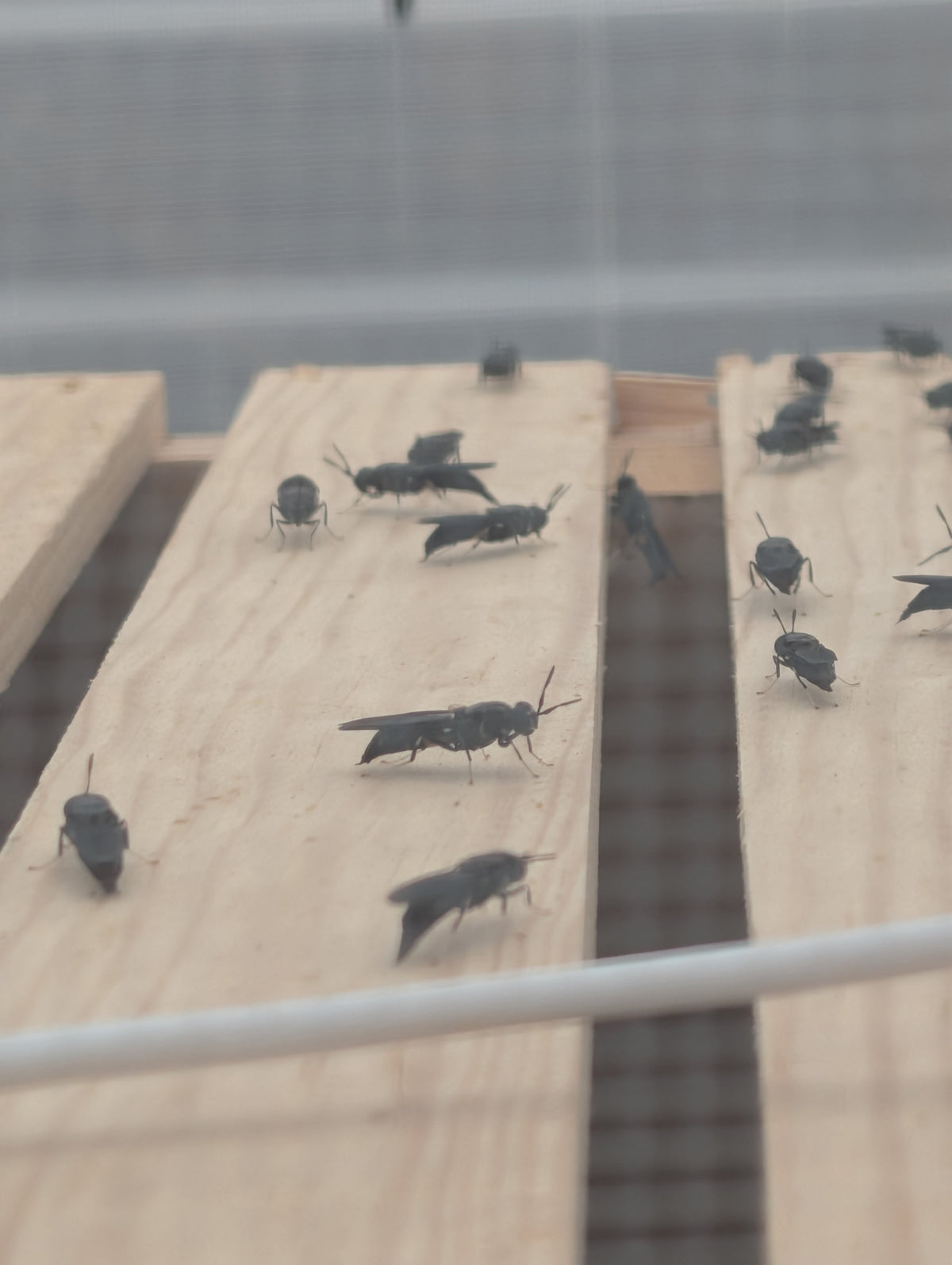
I get asked about this more than you'd think. At our last Repticon show in Denver, a guy picked up a bag of Golden Grubbies, turned it over, and said "so… could I just eat these?" His girlfriend looked horrified. He looked dead serious. I've gotten some version of that question at almost every show we've vended.
The short answer: BSFL are highly nutritious, they're approved for human consumption in the European Union, and they are not currently FDA-approved for human consumption in the United States. That distinction matters, so let's walk through it.
The Nutritional Case
On paper, BSFL are impressive. Roughly 40 to 50% crude protein by dry weight, up to 35% lipids, and an amino acid profile similar to fishmeal. They carry more zinc and iron than lean meat, and their calcium content can exceed what you'd find in milk. The fatty acid profile includes lauric acid, which has documented antimicrobial properties. Chitin, the fiber in their exoskeletons, acts as a prebiotic in early gut health studies, promising results, but the human trial data is still thin.
If you're comparing BSFL to other protein sources purely on nutrition, they hold up well. Per kilogram of protein produced, BSFL need about a tenth of the land, a fraction of the water, and convert feed to body mass roughly four times more efficiently than cattle. No antibiotics, no growth hormones, and they eat food scraps and organic leftovers that would otherwise go to landfill.
Regulatory Reality
The EU authorized BSFL as a novel food for human consumption in January 2022 under Commission Implementing Regulation (EU) 2021/1975. That means processed BSFL products can be legally sold for human consumption in EU member states.
In the United States, BSFL are approved for use in animal feed but have not received FDA approval for human consumption. That's where we are right now. There's no timeline for when or if that changes. If you're in the US, legally, BSFL are animal feed, not people food.
The Cultural Context
Eating insects isn't new. Over 2 billion people globally consume insects as part of traditional diets. Fried insects are common street food in Thailand. Chapulines, grasshoppers, are a staple in Mexican cuisine. Across Africa and Asia, insect consumption has thousands of years of history. The Western aversion to eating bugs is the cultural outlier, not the norm.
That said, BSFL specifically are relatively new to the human food conversation. Most of the insect-as-food industry has focused on crickets and mealworms, which have had more consumer-facing development. BSFL are catching up, primarily because their production economics and nutritional profile are hard to beat.
What Products Exist
In markets where it's legal, BSFL are showing up in a few forms:
- Protein powder, blended into smoothies or used in baking, similar to whey or pea protein.
- Dried and roasted whole larvae, sold as snacks with a texture often compared to roasted nuts.
- Flour, ground fine and used in pasta, protein bars, and baked goods.
- Extracted oil, used for cooking or as a nutritional supplement, rich in lauric acid.
The processing removes most of the "bug factor" that makes Western consumers squeamish, though the whole roasted larvae are still clearly larvae.
Where Blue Grub Farms Fits
We're an animal feed and soil amendment operation. Our Golden Grubbies dried larvae and Frassquatch fertilizer are our products. We don't sell BSFL for human consumption, and we won't until and unless US regulations allow it. But I follow the research and the regulatory landscape closely because the potential is real.
So when that guy at Repticon asks if he can eat them, and someone always asks, here's what I tell him: nutritionally, they're excellent. Legally in the US, not yet. And the larvae he's buying for his bearded dragon is the same animal that two billion people around the world would recognize as food. Whether Western markets get there is a question of regulation and culture, not biology.
