
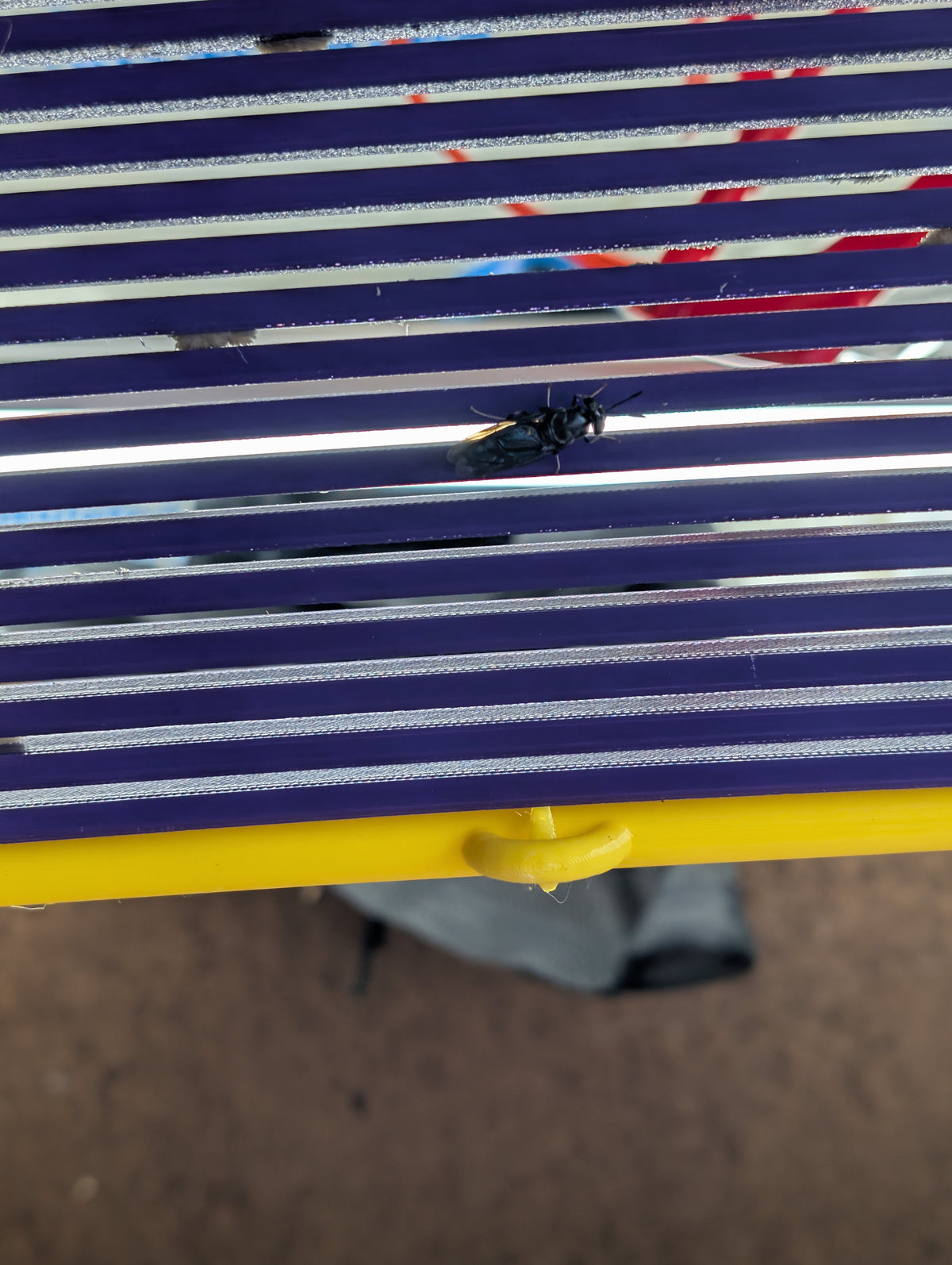
One morning I opened a bin and found half my larvae gone. No smell, no obvious die-off, just a significantly smaller population than the day before. It took me an embarrassingly long time to notice the mouse droppings along the bin edge.
BSFL have predators. If you're running an outdoor system or even an indoor one with gaps in your containment, something is eventually going to find your colony and help itself. Here's what to watch for and what to do about it.
Birds
If your bins are outdoors without covers, you're running a bird feeder. That's it. Sparrows, robins, starlings, they'll work the surface layer and scatter your substrate everywhere. You'll come back to a bin that looks ransacked and wonder what happened until you spot the droppings on the lid edge.
Fine insect netting over the top. Doesn't need to be complicated. I use the same mesh I'd use for a screen door, zip-tied to a PVC frame. Airflow stays fine, birds stay out.
Rodents
I learned that one the expensive way. The mouse from my opener? It wasn't one mouse. By the time I figured out what was happening, I had a family of them nesting under the shelf my bins sat on. Protein-rich larvae plus warm substrate plus a dark corner, I'd built them a resort.
Gnaw marks on bin edges gave it away once I looked. That and the droppings I'd been ignoring for who knows how long. Smooth-sided bins help, but a determined mouse will climb anything. What actually fixed it: elevating the bins 18 inches off the ground on metal shelving, sealing every gap bigger than a quarter inch, and dealing with the existing colony of mice before worrying about the larvae colony. If you've got rodents in the area, that's problem number one. Everything else is downstream.
Ants
Nine times out of ten, ants mean your substrate is too dry. They're not showing up because you have larvae, they're showing up because you dropped below 60% moisture and now your bin smells like an accessible protein source instead of a wet, hostile environment.
Fix the moisture first. Get your substrate back to 60–70% and watch what happens. The ant highways usually dry up on their own within a day or two. If they're persistent, food-grade diatomaceous earth around the outside of your bins creates a physical barrier. Water moats under the legs work too. But I've found that every time I've had an ant problem, I also had a moisture problem. Solve the second one and the first one goes away.
Mites
These are the ones that keep me up at night. You won't see a mite problem coming the way you'll see birds or mice. What you'll see is what looks like white dust moving on the surface of your substrate. Or reddish specks. And by the time you notice, the population is already significant.
Warm, humid environments, which is exactly what your larvae need, are also exactly what grain mites and predatory mites love. They hitchhike in on feedstock. A batch of spent brewery grain, a bag of chicken feed, whatever organic matter you're using as substrate. I quarantine every new feedstock batch now for 48 hours in a sealed container before it touches my main system. Learned that after losing a full tray to a grain mite explosion that came in on a batch of coffee grounds from a local roaster.
If you've already got them: isolate the affected tray immediately. Clean everything, and I mean disassemble and scrub, not wipe down. For ongoing management at scale, Hypoaspis species (predatory mites that eat pest mites) work as biological control. But prevention through quarantine is 10x easier than treatment.
Competing Flies
Houseflies, fruit flies, phorid flies, they'll all try to move in. Here's the counterintuitive thing: if you're seeing a lot of other fly species in your system, it usually means your BSFL colony isn't dense enough. A healthy population at proper density outcompetes everything else for the available food. The other flies can't get established.
So when I see fruit flies multiplying in a bin, I don't reach for a trap first. I ask: am I overfeeding relative to my larval density? Is there uneaten food sitting for more than 24 hours? Almost always, yes. Cut the feed volume, let the larvae catch up, screen any openings in your enclosure, and the problem corrects itself. The larvae do the work for you, you just have to give them the right ratio.
Parasitic Wasps
Less common, but worth knowing about. Several tiny wasp species will parasitize BSF eggs and young larvae. You'd notice them hovering around your egg collection sites, they're small, not the paper wasp type, and your hatch rates drop without obvious cause. Mostly an outdoor warm-season issue. I pull my egg cards indoors within hours of collection now, and screen the oviposition area. Haven't had a problem since.
What Actually Works Long Term
Most of this comes down to system design. If you think about containment from the start, enclosed bins, fine mesh ventilation, elevated off the ground, tight-fitting lids, you prevent 90% of these problems before they start. A well-designed bin with a covered fly entrance and a proper exit ramp keeps the openings predictable instead of leaving gaps everywhere — that's exactly how our BSFL Bin Kit is built. Keep the area around your bins clean. Don't let spilled feed accumulate. Harvest frass on schedule so it doesn't become a secondary pest magnet.
You're running a biological system. Other organisms will interact with it. That's fine. The goal isn't sterility, it's making sure nothing gets established enough to dent your production. Daily monitoring catches problems when they're still small, and small problems are cheap problems.
If you're dealing with something you can't sort out, reach out. We've seen most of them at this point.
